There is something that often happens when an ancient practice meets the West: it gets emptied out. Western teachers and spiritual guides take inspiration from age-old techniques, remove them from their context, rename them and repackage them as "super revolutionary" methods, then sell them for a small fortune in courses, certifications and exclusive retreats.
It happened with meditation, which became a ten-minute practice for escaping from phones. With somatics, reduced to grounding exercises or used as a catch-all label for anything that involves the body. And it happened with prāṇāyāma, which in recent decades has re-emerged in the West under the name of breathwork.
I am not saying that the breath as a practice cannot have value outside the yogic tradition, and indeed, it is right that every technique finds a new use and a new reading depending on society, the historical moment and the problems that afflict the contemporary human being. But there is something that disturbs me in these acts of reclaiming: it is inevitable that, every time an age-old technique is taken out of its context, it loses something essential. It loses its cosmology, it loses its original purpose, it loses the experience accumulated by thousands of people who have practised, studied and passed it down for centuries.
And what remains, often, is only the technique, emptied of its original meaning.
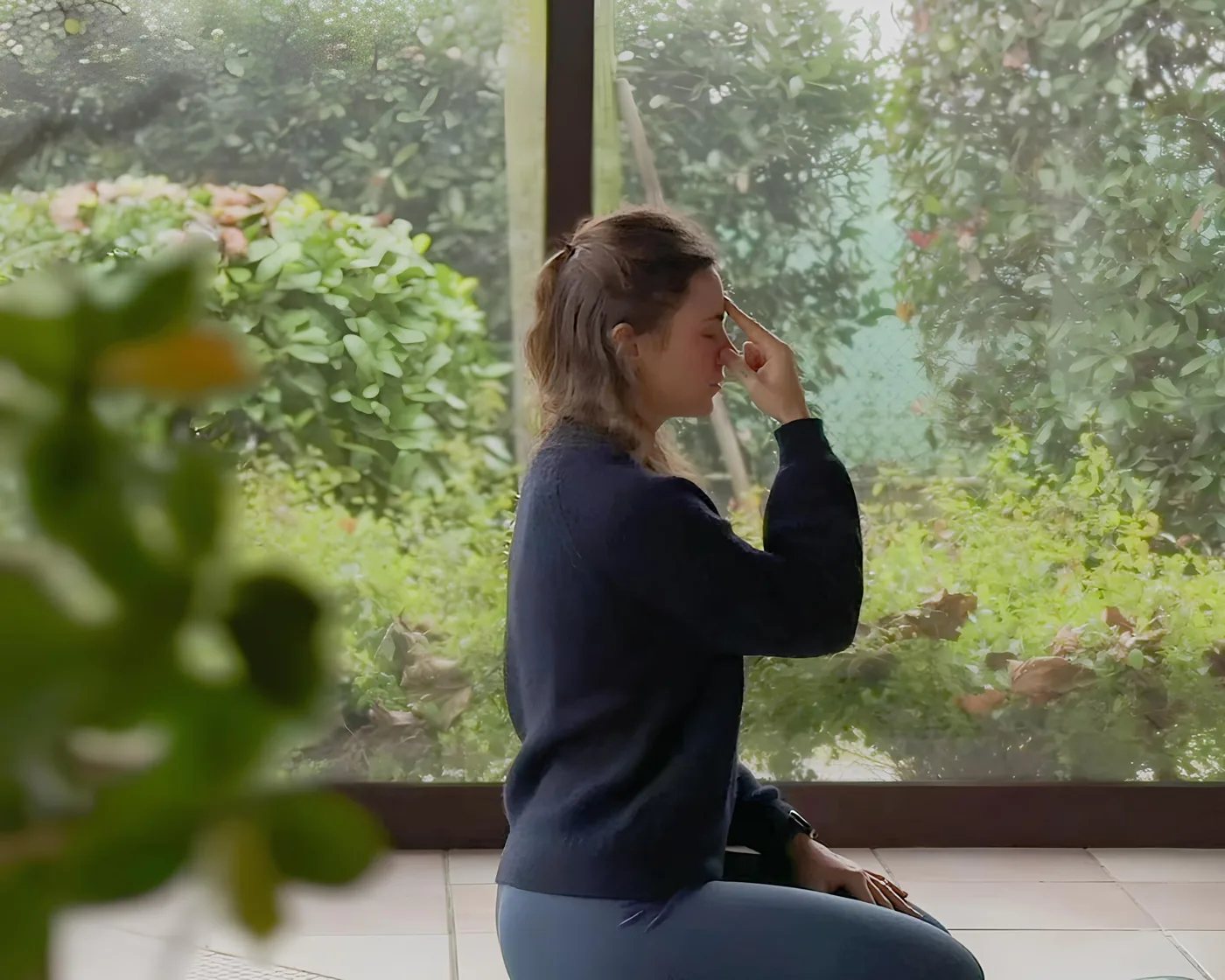
Nāḍī Śodhana, a prāṇāyāma technique for rebalancing the energies in the body.
What is prāṇāyāma
In Italian, or in any other Western language, there is no equivalent of the word prāṇāyāma. This is because the concept of prāṇa is no longer part of our culture.
Prāṇāyāma comes from two Sanskrit words, and there are two versions of its origin:
Prāṇa + āyāma
expansion of vital energy.
Āyāma means extension, lengthening, expansion, prāṇa is vital energy.
In this reading, prāṇāyāma is the practice of releasing and expanding prāṇa in the body.
Prāṇa + yama
control of vital energy.
Yama means control, restriction, discipline.
In this reading, prāṇāyāma is the practice of directing and regulating prāṇa in the body.
And the next question comes to mind... but then this prāṇa, what is it really?
From Swami Sivananda's definition: "prāṇa is the sum of all the energies contained in the universe".
Prāṇa is not a thing: it is what makes all things work. It is not the air you breathe, it is not the food you eat, it is not the sunlight on your skin, but without prāṇa, the air would not keep you alive, the food would not nourish you, the sun would not warm you. All these things carry prāṇa, they are its vehicles.
Prāṇa is the force that animates everything. It is what distinguishes a living body from one that has stopped breathing. The same energy that makes your heart beat, makes the wind blow, makes a tree grow, makes a star explode.
In one word: prāṇa is life. Not an aspect of life, but life itself, in its totality, before taking any form.
That is why translating prāṇāyāma as "control of the breath" is a huge limitation: the breath is not the aim of prāṇāyāma, but one of the means through which prāṇa enters our body.
Prāṇāyāma, then, is expansion and control of the vital force in our body. The techniques of prāṇāyāma, which use the breath as their main tool, aim to revitalise, calm or rebalance the energy of our body - depending on the technique used.
How prāṇa moves in the body
Every living being is immersed in prāṇa. One way in which we absorb it is through breathing, through the main channel of our nose. But we also absorb it through food, through the skin and temperature, and even through thought. Yes, our thoughts also contain prāṇa, they contain energy: when a negative thought takes over, the breath changes, the heart speeds up, the body feels it. Our energy feels it.
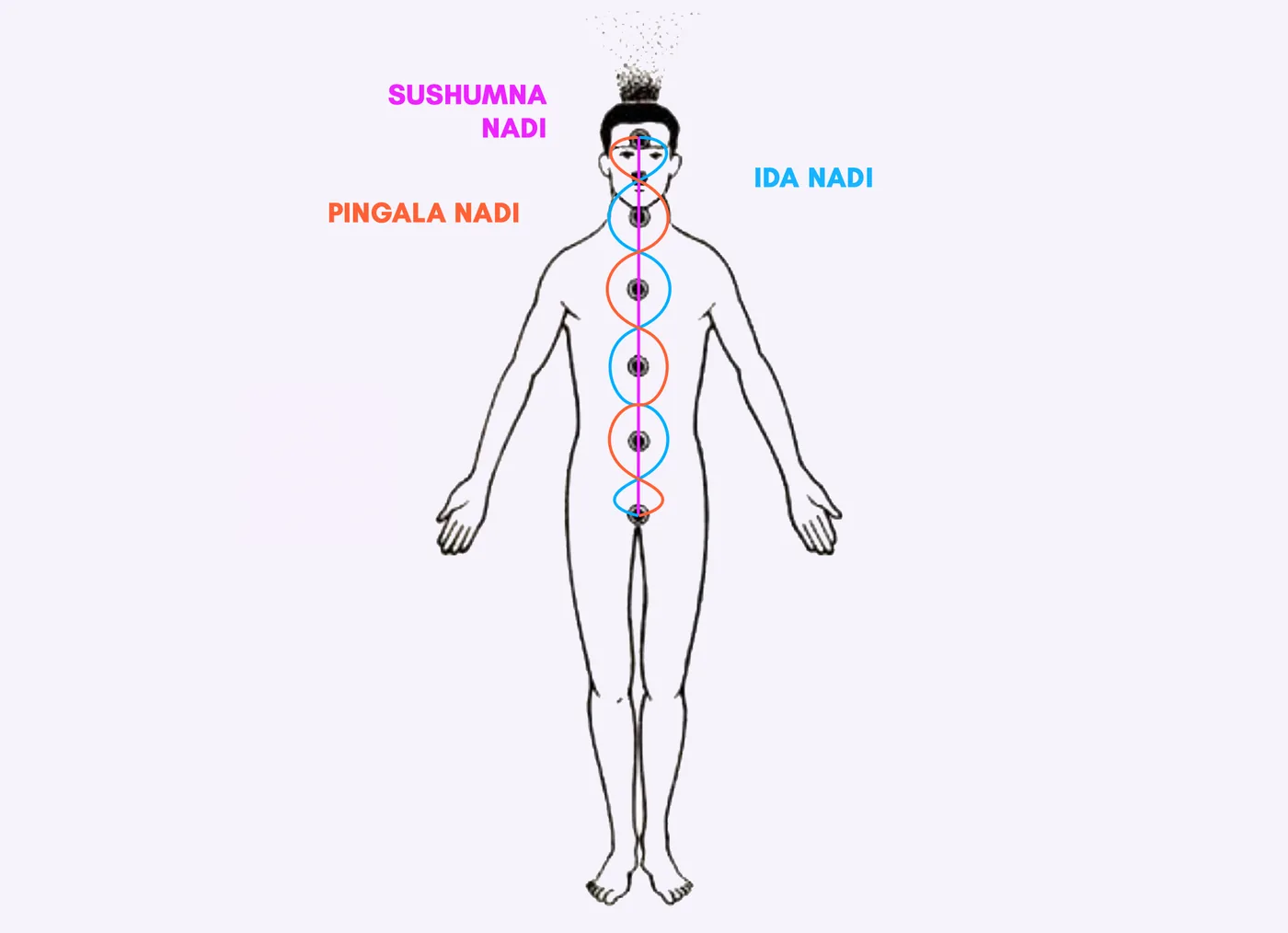
Inside the subtle body, in subtle anatomy, prāṇa flows through a network of energy channels called nadi. Classical texts count tens of thousands of them, but one commonly accepted figure is 72,000. The nadi are a bit like veins which, instead of carrying blood, carry prāṇa.
There are 3 main nadi: the first two are ida and pingala. They originate at the base of the spine and rise, intertwining, to the third eye, at the centre of the eyebrows, and end respectively in the left nostril and the right one. Ida carries lunar energy, so calm, feminine, introspective, while pingala carries solar energy, warm, active, masculine.
The third channel is sushumna, which runs down the centre of the spine. When ida and pingala are purified and balanced, prāṇa can rise through sushumna. This is, in a deep yogic sense, the aim of the whole practice: to create the conditions for a deep awakening of vital energy, which from the lower centres of the body can rise towards the higher ones, bringing balance, clarity and a deeper connection with one's essential nature. (...but we will talk about this another time!)
Why practise prāṇāyāma, and why it should be an integral part of every class
When I propose prāṇāyāma techniques, I sometimes sense a certain distrust. Perhaps because it is not understood what breathing through one nostril has to do with yoga... and once again we come back to how yoga has been emptied of its deepest aspects to make it marketable in the West.
In traditional Hatha Yoga, prāṇāyāma is not an accessory to the practice, but what comes after asana. According to the traditional texts, yoga postures exist to prepare the body to be still and comfortable long enough to practise pranayama, sense withdrawal, concentration and, last of all, meditation.
From a more contemporary point of view, when we work with the breath consciously we are acting directly on the autonomic nervous system, that is, the one that regulates our natural, automatic response to what happens around us.
We live in bodies that are chronically in survival mode, in nervous systems that never fully switch off. Prāṇāyāma is not the solution to all this, but it is an ancient and extremely useful tool for interrupting that cycle: not as a way to optimise the body even more, but as a practice of attention, listening and respect.
From a more subtle point of view, through the breath we work on the flow of prāṇa and on our vital energy. We create the conditions for this to move and remain active and fluid, instead of stagnating.
I often include a prāṇāyāma component in my classes, also to break down the idea that yoga is only physical movement. They are all accessible techniques: the only thing they require is the willingness to stop, feel, experiment.