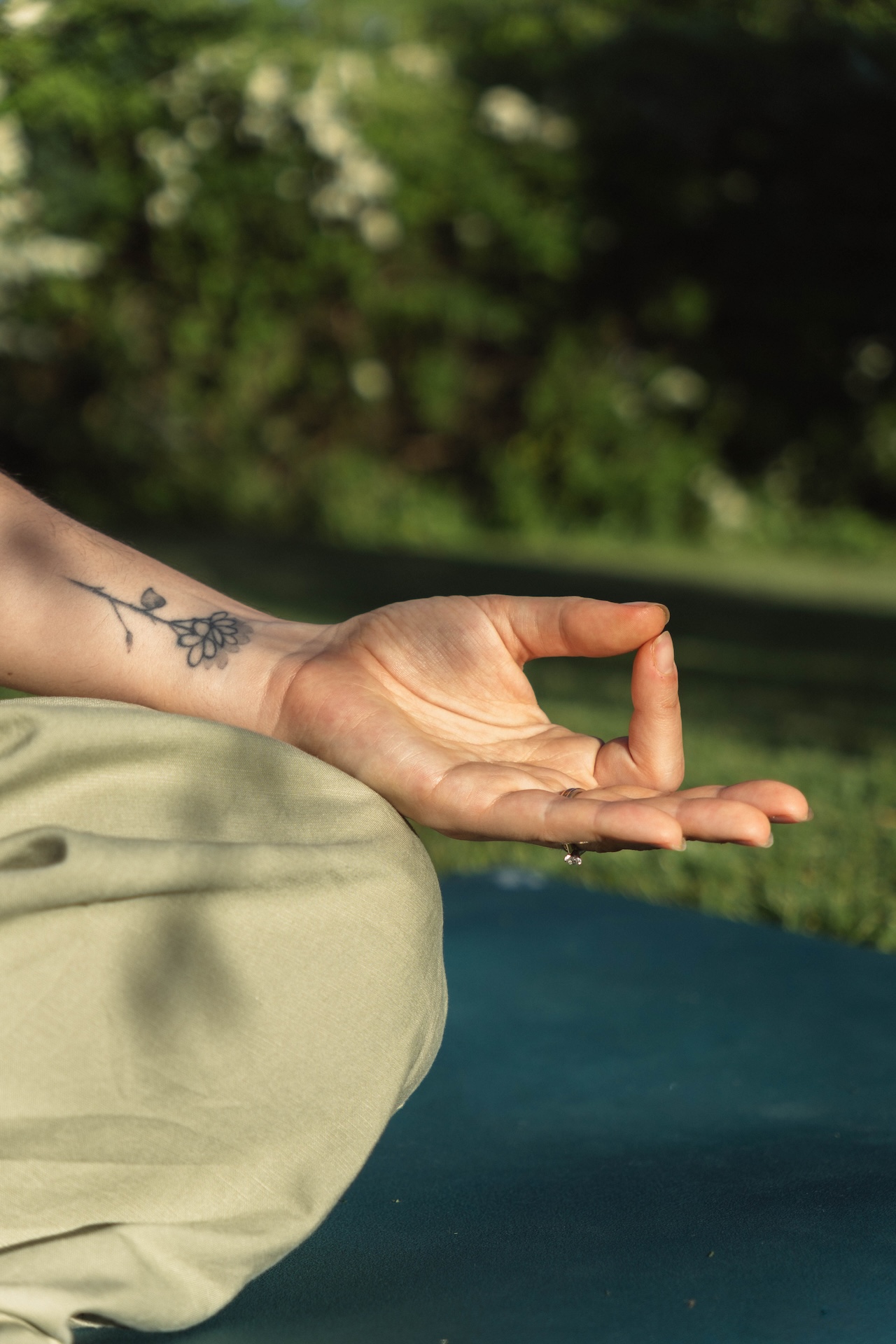
I am lying on the floor, I am crying. Tears slowly roll down my face, falling onto the yoga mat beneath me. My jaw tightens, my throat closes.
From the laptop speaker, the facilitator's voice comes through: "Let it all happen, welcome whatever emotion emerges."
I let it happen. And in doing so, it is as if I am opening a door I did not even know existed.
After years of practising yoga and a year of teaching, in just 90 minutes I discover a new dimension of my body that I had never reached before. Not through theory, not by sitting still for hours in meditation, not by finally managing to master an advanced pose I had always tried to conquer. But only through intuitive movement: something my body has always known how to do.
I enter into such a deep and visceral connection with myself that I feel unstoppable. As if only now I were truly listening to this whole of flesh, tissues, fluids, bones and stars that I am.
Moving without a plan felt like a silent rebellion. I felt alive, free, wild, like an animal finally running free after years in a cage. I was shaking off 30 years of subtle, suffocating control: how I should appear, how I should behave, how I should feel. But it was not only the rules I was abandoning; it was something deeper, something I did not even know existed. A kind of control so ingrained in our psyche that we mistake it for ourselves. So deep that it had become part of us, part of the lens through which we see the world.
Your Body is a Battlefield
We live in a culture literally obsessed with controlling the body.
It is exhausting but deeply necessary to keep repeating how capitalism and social media have distorted our view of ourselves in a sick way. Wellbeing has been turned into another toxic industry, one that now exists only to sell us the next revolutionary tool. The latest fitness trends promise a "perfect" body - perfect, of course, meaning whatever society (or the male gaze) currently deems beautiful. Every day another yoga platform pops up promising to heal your trauma with a 10-day hip-opening challenge, or another productivity guru sells breathwork as the ultimate hack for better focus at work.
And if your body does not conform? Well, you are probably not trying hard enough. With everything we have, by now you should be a superhuman.
Even what were once mindful practices are becoming commodified and rigid - ironically losing precisely the freedom they promise. Yoga has been turned into a business, and all too often what was historically and spiritually meant to be a path towards liberation becomes just another form of control over the body. There are countless examples of abuse of power in wellbeing and spirituality spaces (this series of articles on Osho keeps coming to mind, and in general everything Margarit Davtian writes on her Substack) where vulnerable people are exploited for personal gain, whether through uncomfortable and unwanted hands-on adjustments during class (which happen far too often), expensive retreats, or blind devotion to a "guru".
And we really do need to say it: the female body continues to be treated as the ultimate controllable object.
A woman's body is still legislated in courtrooms (where abortion rights are stripped away under the mask of "morality"), monetised on screens (where Instagram algorithms reward only the thinnest, whitest, most flexible bodies), and used as a weapon in workplaces (where "professionalism", for women, still means smiling, making yourself small, and never taking up too much space). Even the "body positivity" movement has been hijacked by brands, repackaged as self-love... as long as you buy the right leggings.
Our bodies are no longer bodies: they are projects to be optimised, lifeless structures destined to be sculpted into society's shiny, suffocating cage. We have reduced ourselves to shells, emptied out and repurposed for hyper-efficiency, our minds sharpened for a world that demands everything and gives nothing in return.
A woman's body is never just hers: it is a battleground for power, profit, judgement. And the moment that woman dares to step outside the narrow boundaries of what is expected of her body, she is met with rejection, ridicule or erasure.
And in this world, it is natural that we learn to manage it by retreating into our shell: silencing the alarms our body sends us, not fighting, but succumbing. Allowing ourselves to be domesticated, letting society pour into us, shaping our personal view. This surrender is passed down from generation to generation, until we become part of the very system that represses us. Until we forget who we were, until our voice is completely silenced - spreading through every choice we make, through every gesture we make.
"The poorest barter of our lives is the one we make when we give up our deep knowledge of life for one that is much more fragile; when we give up our teeth, our claws, our senses, our sense of smell; when we give up our wildest nature for the promise of something that looks rich but turns out to be empty."
~ Clarissa Pinkola Estés
Unlearning the Rules
Many of today's somatic practices have their roots in Bonnie Bainbridge Cohen's Body-Mind Centering (BMC), an approach that shows how our bones, muscles, organs and fluids are more than just physical structures: they are living, intelligent parts of us, each with its own voice and memory. Drawing from animal and infant movement, BMC reminds us that our bodies already know how to express themselves, heal and thrive. As Linda Hartley, practitioner and author of Wisdom of the Body Moving, describes it, BMC is a way to "deepen the intuitive wisdom of the body" and nurture our inborn capacity to heal through awareness and touch. It invites us to see our bodies not as single entities, but as a community of bones, organs and cells.
Inspired by this and by my current training in Authentic Flow (from the wonderful Satu Tuomela, more info here), a few weeks ago I put on a song at the end of class, just before shavasana, inviting people to move freely while lying on their mats. When I told them they could make any movement that felt right, following the music and letting their bodies speak without the interference of the rational mind, I sensed that for some it was difficult - perhaps because moving from a class where every movement is guided to suddenly having no direction at all felt too abrupt. Some stretched a little, then moved straight into shavasana. I am still learning how to make this transition as fluid as possible for people who have never really let their bodies take the lead, as I feel that freedom has become more unsettling than following instructions.
For me, intuitive movement is exactly this: creating space for the body to speak for itself. To move from within. It is a practice in which movement follows internal rather than external cues, rejects rules and performance goals, and gives priority to listening over doing.
This is why intuitive movement has the potential to resonate so deeply with so many of us: first of all, it is accessible and inclusive for all - all bodies, all shapes, all ages, all abilities, all experiences.
It is not about being good or doing the right thing: we need to let go of the idea that movement has to be "correct" in order to be valid. Here there is no right or wrong. There is only listening to your body and letting it express itself as it wants.
It is a necessary and radical practice that opens space to explore what feels good and needed in the moment. It is a way to truly reconnect with our bodies, to push back against cultural conditioning, and to stop delegating authority over our bodies to others.
Intuitive Movement as an Act of Liberation and Resistance
I did not feel it right away, maybe it took a few days. After that class I attended, I felt a new power growing inside me, as if I had found a stronger, clearer voice. I felt empowered. I felt whole, on my own. I felt the little girl I was, the one too scared to speak, too unsure to take up space, who found refuge only in the pages of books, who spent most of her life feeling out of place. I felt her power finally released, as if every struggle, every wound, every moment of not belonging finally made sense.
That first session of intuitive movement, or embodied yoga, somatic movement, whatever label you want to give it... it gave me back my agency. It was as if I had rediscovered my teeth, my claws, my sense, my sense of smell - ready to break the structures around me.
The very first thing I felt free enough to do was stop plucking my eyebrows. It seems like such a small thing, but it was something I had felt compelled to do for literally half my life: carefully shaping and taming my dark, Mediterranean, thick eyebrows. A small act of rebellion.
We are living through a global crisis of disembodiment. Our bodies were made to run, stretch, tremble, but instead we train them to function like machines. We spend our lives with our nervous system in a state of alert. Our bodies and our minds are breaking under systems that were never designed for us to thrive. And what do we do? We smother the signals with more work, more distractions, more control.
Our body is the first place where we learn to obey. From a young age, we are taught to sit up straight, not to cry, not to be "too much." We learn that we must be strong. We absorb the idea that the body is something untameable, sometimes even dirty, while the mind is what really matters: we must study, work, be efficient. The body is something to discipline and keep still.
Intuitive movement asks us to undo this perception, placing embodied awareness as the basis of personal empowerment. Because when we change our relationship with the body, we inevitably change the way we relate to the world.
We become fully awake. We tune into our needs and desires, we know what we want to bring into the world and what we can no longer accept. We find our true voice and feel the need to resist disconnection, alienation, and everything in society that now feels wrong or imposed. We question everything we once accepted without asking.
And as we begin to trust our bodies and recognise that they are ours, not something to be controlled from the outside, we begin to question other forms of control as well. Allowing ourselves to be vulnerable becomes an act of resistance in a culture that demands constant strength, even in the face of pain, exhaustion and overwhelming emotion.
Reclaiming intuitive movement, then, is a quiet but radical gesture, one that pushes back against a system that profits from our disconnection. When we move freely, we challenge the idea that our bodies exist to perform, conform or produce. Instead, we affirm that our bodies are ours to inhabit, ours to live in, ours to nourish.
"General Wolf Rules for Life:
Eat, Rest, Rove in between, Render loyalty, Love the children, Cavil in moonlight, Tune your ears, Attend to the bones, Make love, Howl often.
~ Clarissa Pinkola Estés"
Thank you so much for reading. It fills my heart, because I was longing to put these words into the world. Stay wild, while keeping your gentleness ♡
Important note: I am not an expert in the topics I wrote about above. I have been practising yoga for years, but my immersion in somatic practices is still fresh, only a few months old. I am writing because something inside me needed to be shared. I felt the need to put this experience into words.