The very first time I took part in a sound bath was in Rishikesh, in India, immediately after finishing my 200-hour yoga teacher training course. Some friends were going and I joined them, hungry for new experiences before going back home.
I still remember how we walked a bit aimlessly through the narrow alleys of Tapovan, looking for the right address, as dusk was falling. When we finally found the place, we climbed several flights of stairs to reach a room lit by a soft light, full of instruments whose names I did not even know. Five places already prepared for us.
I lay down, settled in and closed my eyes. And during that hour I felt something I had never really felt before: I felt the sound with my whole body. At one point, the facilitator placed a Tibetan singing bowl directly on my chest: the vibration moved through my ribs, my lungs, my spine... I loved it so much. But my mind was too awake: you know when they say "let go of the rational mind, do not try to analyse every sound"... I was doing exactly that. My mind was still too rooted in logic (even after a month in India), and although I felt the power of this practice, I also felt I did not have the tools to understand it.
The second time happened only a few days ago. A gong bath in the school where I am training in Bologna.
In the year and a half since Rishikesh, I have deepened a few things. I read, I studied, I started practising sound baths under the guidance of the same teacher who first welcomed me into this world in Rishikesh. Now I know more, even if I am still a beginner.
When my teacher opened the session with "Leave your life outside the door, let yourself be absorbed by the vibrations, let them move through your body and switch off the rational mind," I tried to set my mind aside and let the body lead.
And yes, this time it was very different.
I did not notice the hour passing, but my body felt everything. Six large gongs, their vibrations hitting me in very strong waves. At times it was even too much: my body would tense up, resist. Then I tried to soften, to let the vibrations pass through me without judgement, without attachment to what I expected from the experience.
In the end I felt shaken, turned inside out. I could feel how my energy had moved: in some parts of the body something was flowing more freely. In others, especially the heart and throat, I could sense blocks: at times during the bath the heartbeat was accelerated and the breath even became difficult. As if an elephant were pressing down on my chest.
I do not think I had ever felt my body with such intensity before.
What happens during a sound bath
Thanks to what I had learned, I was able to give a kind of "rational" explanation to the sensations I had felt during these two experiences.
One of the very first things to know is that sound changes the state of our brain.
Our brain produces electrical activity at different frequencies, measured in Hertz (Hz). These frequencies correspond to different states of consciousness:
Gamma Waves (30-100 Hz):
hyper-awareness, peak cognitive function, deep insight.
Beta Waves (12-30 Hz):
the state we usually find ourselves in when awake. Active thinking, problem-solving, attention directed at the external world. But too much time in this state leads to stress, anxiety, mental fatigue: this is where most of us are stuck.
Alpha Waves (8-12 Hz):
we are alert but relaxed, daydreaming. Light meditation. A bridge between the conscious mind and the subconscious mind.
Theta Waves (4-8 Hz):
deep meditation, light sleep, REM dreaming. The gateway to creativity, intuition and the subconscious. This is the state of deep mental rest.
Delta Waves (0.5-4 Hz):
the slowest waves, which occur during dreamless deep sleep. Essential for physical healing, cell repair, regeneration.
Sound healing works through brainwave entrainment: the brain naturally synchronises its electrical activity with external rhythmic sounds. That is why shamanic drums, which beat at around 4.5 beats per second (in the Theta wave frequency), have been used for millennia to induce trance states.
Tibetan singing bowls and gongs do the same: they guide the brain from the stressed, overstimulated Beta state towards the restorative Alpha, Theta or even Delta patterns - through resonance. Resonance is what happens when two vibrating systems naturally synchronise, like two pendulums in the same room that eventually start swinging together, or like when you start tapping a foot in time to a song.
The brain does the same: when it consistently hears a frequency, it follows it.
How sound reaches the nervous system
This slowing down of the brain obviously has a big impact on our whole body and on the nervous system.
In our lives we are constantly in a state of chronic activation. The sympathetic nervous system (which determines the fight or flight response, "attack or flee") is most of the time active in silent mode, even when there is no real threat. Modern life asks us to be always vigilant, always ready, even during rest (... thanks, social media).
When sound guides the brain towards slower waves, the nervous system follows. The parasympathetic response (rest and digest) finally has the chance to activate. Heart rate slows, blood pressure drops, cortisol decreases.
But here is the point: when the body finally feels safe enough to let go, issues previously suppressed or hidden can re-emerge. It is the same principle at the basis of somatics and other somatic practices whose aim is to reconnect with the body without filters.
The signals I was receiving, such as the tension in my chest and the difficulty breathing, did not mean that something was wrong. It was a sign that the body finally had a way to let go and that it had been affected in an extremely deep way by the experience.
The sound that passes physically through you
The human body is made up of 70-80% water. Sound travels through water four times faster than through air. When a gong or a Tibetan singing bowl vibrates, that vibration does not stay on the surface of the body: it spreads inward, through tissues, fluids, cells. Like an internal massage.
Every organ, every tissue has its own natural frequency: a speed at which it vibrates when it is healthy. When we are stressed or tense, those frequencies can change. Once again, thanks to the principle of resonance, when an external frequency meets a similar internal frequency, they start vibrating together.
That is why sound is not felt in the same way throughout the body. The places where the vibration flows freely are the open ones. The places where it meets resistance, where a feeling of blockage or excessive intensity is felt, are the ones that are holding something. Perhaps tension, unexpressed emotions, or years of shutting down.
That is what I felt in that gong bath: the sound revealing tensions of which I had some awareness, but which I had never felt so present in my body. It did not create the block: on the contrary, it helped me become aware of it, to become conscious of something that was already there.
Why you might want to try it
We live in a world that never lets us switch off our minds. We are constantly asked to stay activated, in a state that responds to the demands of today's society... but perhaps not to our own.
Sound baths offer a way, first of all, to let mind and body rest without anything being asked of us. They are a way to allow yourself a moment of rest, not through effort or yet another technique to master, but simply by lying down and letting the vibrations do their work. And sometimes, if you are truly open, something may move.
If you have tried meditating and your mind will not stop, sound gives you something to anchor to. If you are exhausted and the idea of learning another practice feels like too much, this asks nothing of you, only that you receive. If you are curious to know what your body might be holding, sound can help you - not by forcing, but by creating the conditions for something to emerge.
The research is not yet catching up. A 2016 study looked at 62 people after a single sound meditation session with Tibetan singing bowls: significant reductions in tension, anxiety, depression and even physical pain were recorded. Those who had never tried it before showed even greater effects. A 2025 systematic review analysed 19 clinical studies and found potential benefits for anxiety, depression, sleep and cognitive functions, although further research is needed.
You do not need to believe, you do not need to "know how to meditate": your body will respond anyway.
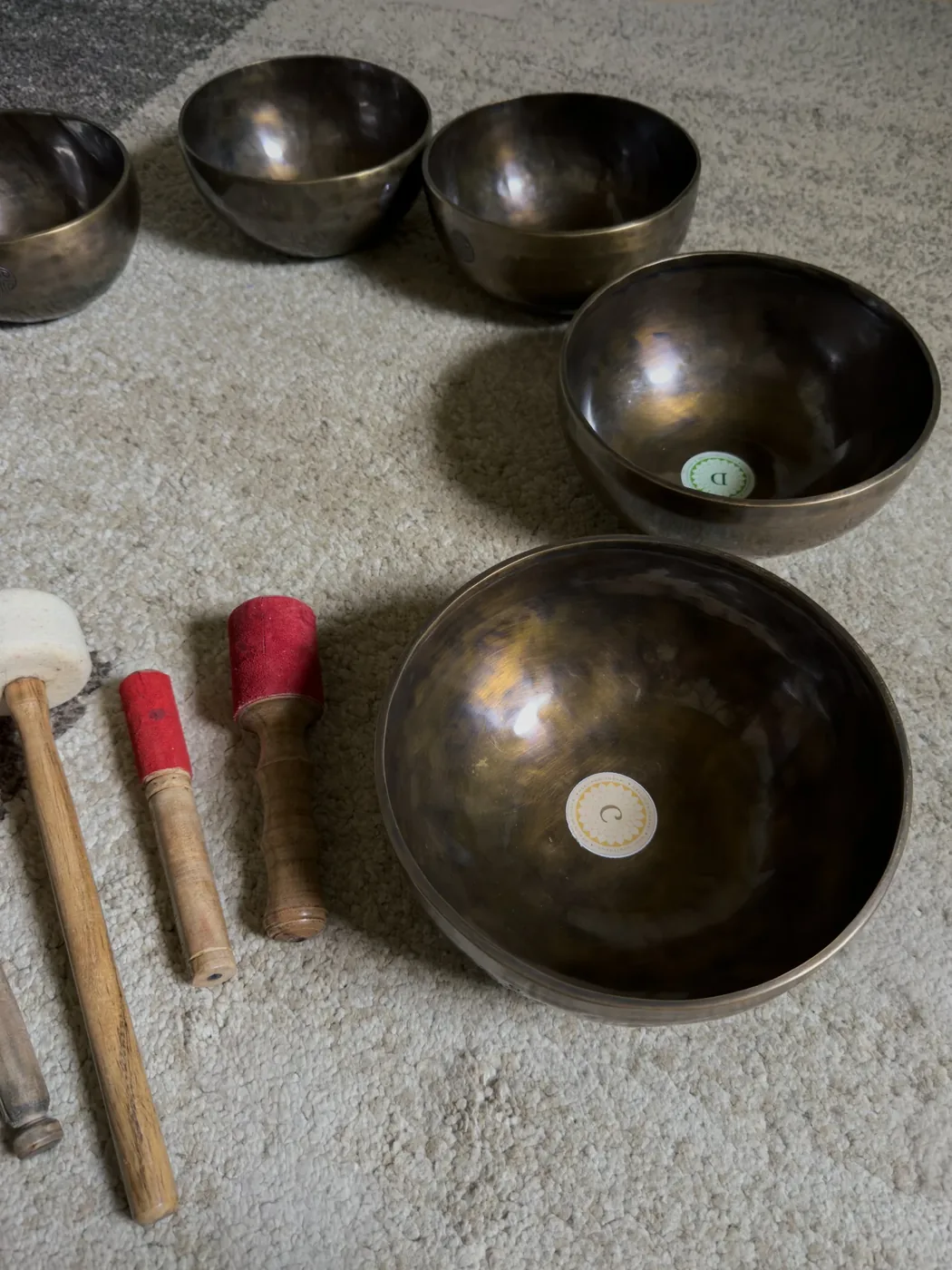
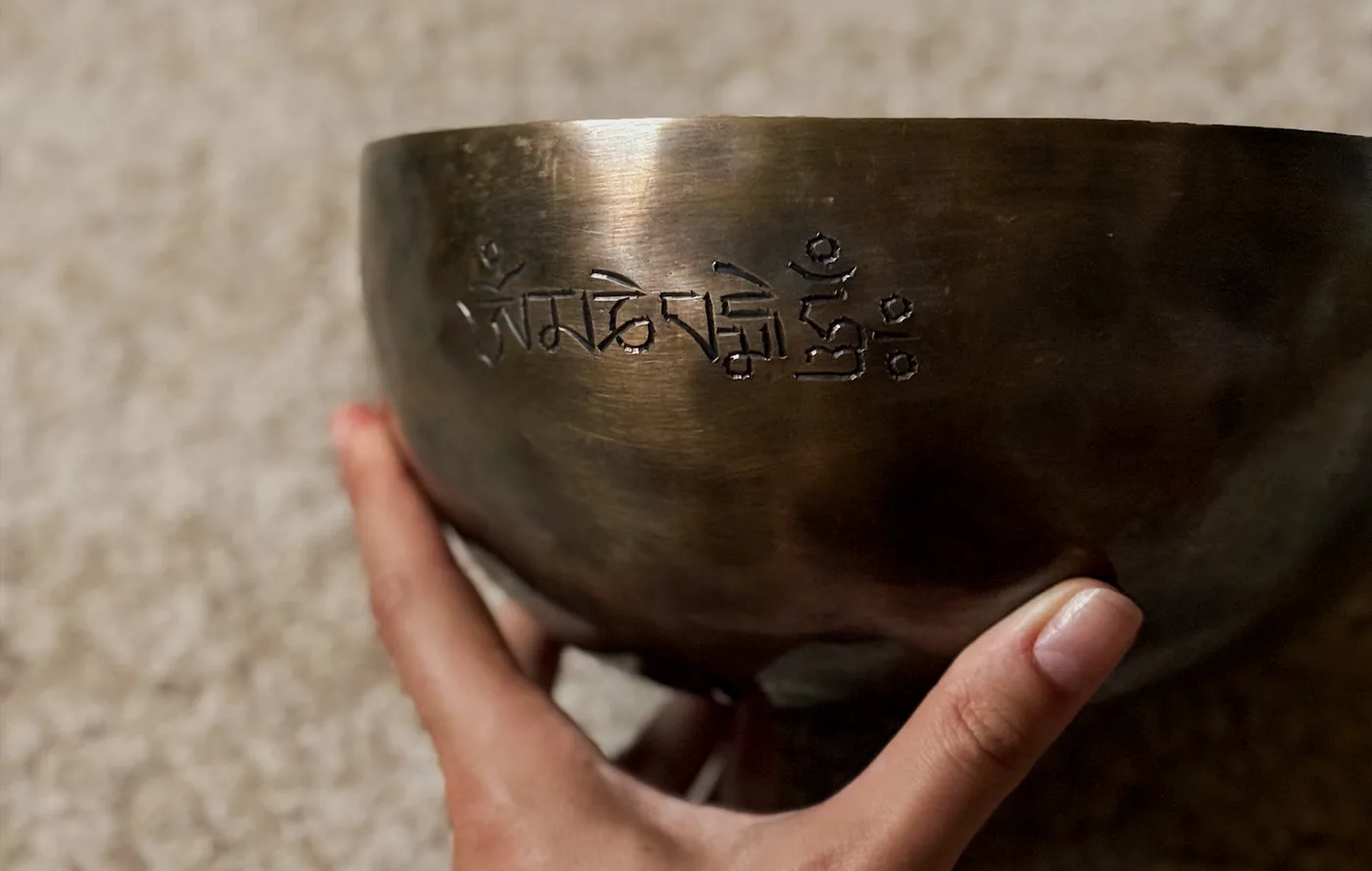
My first collection of Tibetan singing bowls <3
A bit of history: Tibetan singing bowls have been used for almost 4,000 years, originating in the kingdom of Shang Shung in what is now western Tibet. For centuries, monks in Tibet and Nepal have used them in spiritual ceremonies and healing rituals, long before anyone tried to measure brainwaves or map the nervous system.
Legend has it that the bowls were already powerful, but that something was missing. The monks appealed to higher beings for help and, in response, a shower of meteorites was sent to Earth. Since then, it is said that meteoritic iron, known in Tibet as thogcha, or "sky metal," was added to the alloy used to make the bowls, giving them unique properties. Modern analyses suggest that this was a rare event, if not entirely legendary. But whether the legend is true or not, what remains is a tradition passed down for millennia, kept alive by those who understood its power.
I approach this tradition as a student, not as an expert. I do not come from the Tibetan or Nepalese tradition and I do not claim to pass on knowledge that is not mine. What I can do is share what I have studied, what I have practised, what I have felt... and offer a doorway into this world to anyone who is curious.
Thank you for reading this article and for taking the time to explore and deepen your understanding of this practice.
Stay wild, stay tender - always ♡